
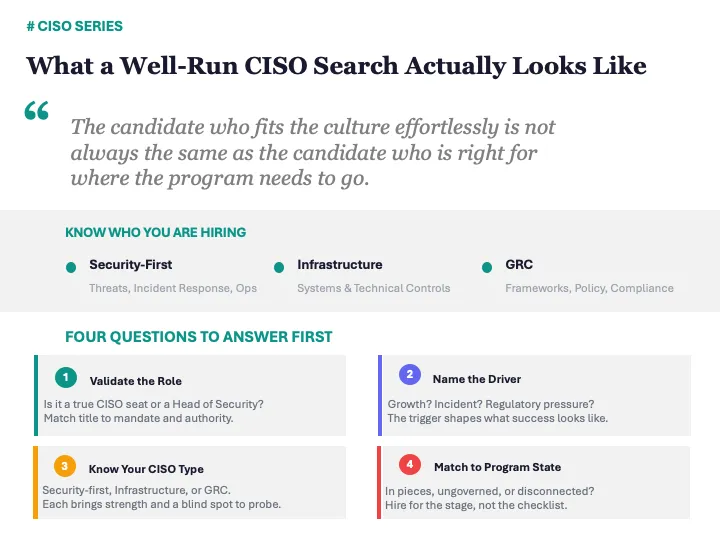
A CISO job description is an organization’s first public statement about how clearly it has thought through this hire. Most job descriptions say the same thing. CISSP required. Ten-plus years of experience. Familiarity with NIST and ISO 27001. Strong communication skills. A line about cloud. This checklist is not wrong. It tells you someone is qualified. It doesn’t tell you if they’re right.
The searches that produce the right hire answer those questions first: whether a CISO is even the right role to build, what is actually driving the search, what the program needs, and what type of leader fits this specific moment. This article is about that work.
Do You Actually Need a CISO?
A CISO is an executive with an independent mandate for enterprise risk: someone who can speak to the board directly, whose authority runs across the organization, and whose job is to translate security risk into terms the business can act on. That requires the right leader and a structure built to support the role.
Not every organization is ready to build that function, and there is nothing wrong with that. A company that needs someone to manage security operations, run the technology controls, and keep the program running may be better served by a Head of Security or a VP of Information Security inside the technology organization. That role has tangible value. Calling it a CISO when the mandate, the authority, and the reporting structure say otherwise sets up the search, the hire, and the organization for a mismatch that is hard to unwind.
You can usually read it in the structure. If there is no independent path to the board or CEO, if budget authority runs through another function, if the scope is operational rather than enterprise risk, the organization may not be building a CISO seat yet. It may get there. Right now it is something else, and naming it honestly tends to attract the right candidates and set clearer expectations for everyone.
The right Head of Security candidate may have CISO-level credentials, and that is not a problem. The question is whether both sides understand what is actually being built. Giving a title for its own sake rarely ends well. The organization does not get what it thought it was hiring, and the person in the seat spends their time managing a gap between their mandate and their title that should have been resolved before the search started.
What’s Actually Driving the Search
The motivation shapes everything downstream: what the organization needs from the role, what success looks like once someone is in the seat, and what kind of leader will thrive in the environment they are walking into.
The program outgrew the dual hat. A technology leader has been carrying security alongside a full portfolio, and the complexity, regulatory load, or visibility of the function has reached the point where it needs dedicated leadership. This is a healthy and common trigger. The productive question to answer honestly is whether the organization is ready to give the role real authority alongside the other executive functions, not just capacity relief.
External pressure created the mandate. A regulator required a dedicated function, the board called for it after an audit, or an investor made it a condition. The best organizations in this situation treat the mandate as an opportunity to make a genuine investment in the function, not just satisfy the requirement. The job description and the search process will reflect which of those two things is actually happening.
Something went wrong and the organization is ready to respond. A breach, a significant audit finding, or a near-miss created urgency. The organizations that handle this well are honest about what they need in the near term: someone who can stabilize the situation, communicate credibly to regulators and the board, and build toward a durable program. Naming both of those needs in the search produces better outcomes than collapsing them into a single vague “program builder” requirement.
Proactive investment ahead of growth or change. The organization is scaling, going through transformation, or heading into M&A and leadership decided to get ahead of the risk curve. This is the clearest context to hire into. The organization knows what it is trying to enable, which makes it possible to hire specifically for it.
The role evolved past the person in the seat. Security leadership has a way of outpacing the people who built it during an earlier phase. An organization that scaled significantly, moved through major technology transformation, or entered a more complex regulatory environment may find that the CISO who was exactly right three years ago is not positioned to lead what the program needs to become. This is one of the more delicate searches to run well. The new hire is being asked to build on a foundation someone else created, often while that person is still present. Being clear internally about what the role requires now, distinct from what it required before, makes the evaluation sharper and the transition more likely to succeed.
The previous CISO moved on. This context is shaped almost entirely by why the last person left. A voluntary departure under good terms is a different search than a structural mismatch that was not resolved. Organizations that spend time understanding what the previous engagement looked like, what worked, and what the role actually needs now tend to write better job descriptions and conduct more useful interviews.
The CISO Types
Understanding what is available in the market, and what the organization can accurately evaluate, is the other half of the work. Most CISOs come from one of three professional orientations, each with real strengths and areas where judgment takes longer to develop without specific experience.
The security-first CISO grew up in the craft: threat intelligence, red team operations, SOC leadership, incident response. They understand adversaries and they know how to make calls under pressure. Their instincts are often ahead of their documentation. Organizations with mature technical programs that need a sharper operational edge, or that have faced a real incident and want someone who has been in that situation before, will often find this profile fits well. The area to probe is business risk fluency: whether they can translate what they know about threats into terms that shape executive decisions and resource allocation, not just operational response.
The infrastructure CISO came up through systems, networking, and engineering. They have built real things and carry the credibility of someone who has. This orientation produces strong defensive architecture and technical control programs. Organizations going through significant technology transformation, managing complex infrastructure environments, or building security capability on top of a strong engineering culture often find this profile aligns well. The area to probe is governance and board-level communication: whether they can operate as effectively in the risk conversation as they do in the technical one.
The GRC-first CISO brings structure and rigor that many organizations genuinely need. A background in policy, audit, and compliance produces someone who can build frameworks, manage regulatory relationships, and bring coherence to programs that have grown without governance. Organizations with significant regulatory exposure, or programs that have good technical capability but no coherent risk framework, will often find this profile transformative. The area to probe is operational credibility: whether they have enough first-line experience to earn the trust of technical teams and make sound calls when a framework does not have a clear answer.
No single orientation produces a complete leader, and the best practitioners tend to develop range across all three over the course of a career. The goal is not to find someone who checks every box. It is to understand which orientation fits the program’s current state, what will need to be developed over time, and what can be addressed through the team the CISO builds around them.
One dynamic worth naming: the visibility of the CISO role creates natural pressure toward a hire who fits comfortably with the existing structure. Organizations that recognize this tendency and account for it in the evaluation process tend to make cleaner decisions. The candidate who fits the culture effortlessly is not always the same as the candidate who is right for where the program needs to go.
Match the Hire to the Program’s Actual State
Before writing the job description, it is worth mapping where the program actually stands against what it needs next. The table below is a starting point, not a formula. Most organizations sit somewhere between these states.
| Program State | What It Looks Like | What the Search Should Prioritize |
|---|---|---|
| Security in pieces | Tools exist, and there may be compliance activity or reactive IT support, but no dedicated ownership, no coherent structure, and no one accountable for the risk picture | A proven builder. Not someone who inherited or optimized, but someone who has built a functional program out of disconnected parts. Different capability, different interview. |
| Built but ungoverned | Activity without a risk framework; compliance functions running independently; board reporting nobody quite believes | Governance depth. Someone who can impose structure and create coherence without dismantling what’s already working. |
| Technically sound but disconnected | Strong controls, weak business alignment; fluent with engineers, struggles in the boardroom or in executive risk conversations | A business leader who runs security. Not a security leader who occasionally briefs executives. The distinction is real and shows up in how they operate every day. |
The honest version of this diagnostic is often more nuanced than any single row. Programs have strengths in one area and gaps in another. What matters is being specific enough about the current state that the job description and the interview process are both aimed at the right target.
Design the Interview to Surface What Actually Matters
Once the diagnostic work is done, the interview has a clear job: confirm whether the candidate’s orientation and experience match what the program actually needs at this stage.
Organizations that have done the diagnostic work enter interviews with a specific frame. The questions that matter emerge from that clarity. Organizations that skip the diagnostic are asking the interview to do work that should have happened first. The interview confirms. It does not diagnose.
The organizations that get this right know what they need before they start looking. That changes everything about who they find.